Methods
This page summarizes the CLIMB and CLIFF algorithms as implemented in this package, simplified from the Methods section of Coudray et al., Computational deconvolution of drug sensitivity via single-cell–to–bulk transcriptome mapping (manuscript in revision). See the paper’s Methods and Supplemental Methods for full derivations.
CLIMB: cell-level linear model for bulk-to-single-cell deconvolution
Unlike deconvolution methods that fit one coefficient per cell type against a signature matrix of average expression, CLIMB fits one coefficient \(\alpha_i\) per individual single cell \(i\) in the reference. For a bulk sample \(n\) with expression vector \(\mathbf{x}_n\), and a reference matrix \(\mathbf{C}\) of raw single-cell counts (\(G\) genes \(\times\) \(C\) cells):
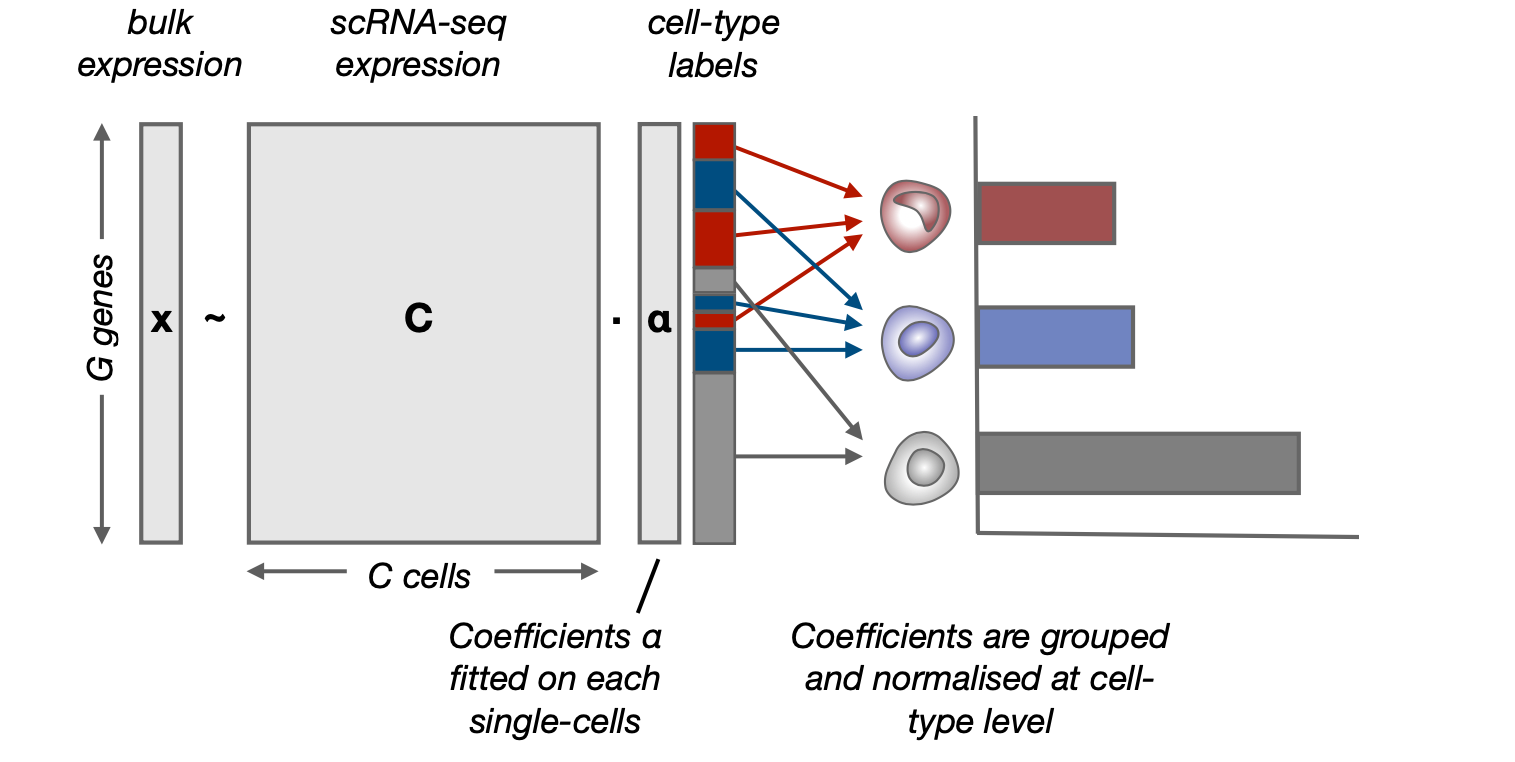
Coefficients are fit with glmnet, under a non-negativity constraint and no regularization:
Cell-level coefficients are then grouped and normalized by cell-type annotation to obtain proportions \(w_{nk}\) for cell type \(k\):
where \(\tau_{ki}\) is 1 if cell \(i\) is of type \(k\). This first pass is returned as props.init.
Empirical Bayes sub-sampling
A single fit against the full reference is biased toward the reference’s own cell-type composition. CLIMB corrects for this with an iterative sub-sampling step: cells are resampled from the reference according to the current proportion estimate (with a floor of min.n.cells cells per type), CLIMB is refit against the resampled reference, and the process is repeated across n.iter.subsampling resamples, averaged, over two rounds. The result — less biased toward the raw reference composition — is returned as props.corrected, and is CLIMB’s main output for downstream use.
Cell-type expression deconvolution
When run with mode = "expression", CLIMB additionally predicts cell-type-specific expression in two parts:
Mapping-based expression — summing the expression of cells assigned to each type by the fitted coefficients (\(s^{(mapping)}_{ngk} = \sum_i \alpha_{in} \cdot c_{ig} \cdot \tau_{ik}\)). This captures expression already present in the reference.
Residual expression — for genes differentially expressed between the bulk sample and the reference (assumed to originate mainly from cancer cell types), the residual \(\epsilon_{ng} = y_{ng} - \hat{y}^{(mapping)}_{ng}\) is used to fit an additional correction term, learned jointly across all bulk samples.
The two components are combined into the final high-resolution expression estimate, returned as expr.highres (per-sample) and expr.overall (averaged across samples).
CLIFF: cell-type-specific drug sensitivity via Expectation-Maximization
CLIFF takes CLIMB’s cell-type proportions and expression as fixed inputs, together with bulk drug-response data, and infers a latent per-cell-type survival probability \(\pi_{kn}\) for each cell type \(k\) and sample \(n\). The observed bulk survival rate \(y_n\) is modeled as the proportion-weighted mixture of these latent probabilities, and \(\pi_{kn}\) is linked to cell-type expression through a sigmoid model with coefficients \(\tilde{\boldsymbol{\beta}}\).
Because the resulting log-likelihood is not directly tractable, CLIFF is fit by Expectation-Maximization:
E-step — using the current \(\tilde{\boldsymbol\beta}\), compute responsibilities \(q^{(0)}_{nk}\) and \(q^{(1)}_{nk}\) that assign each observed outcome to the cell types most consistent with it, weighted by cell-type proportions.
M-step — with those responsibilities held fixed, refit \(\tilde{\boldsymbol\beta}\) by a weighted logistic regression, updating \(\pi_{kn}\).
The two steps alternate until early stopping (the fit-to-data error plateaus). The default starting point, \(\tilde{\boldsymbol\beta} = 0\) (equivalently \(\pi^{(t=0)}_{kn} = 0.5\) for all cell types), requires no tuning and was found empirically to be among the best-performing initializations tested.
Note
Internally, CLIFF recenters the input auc values so their mean is exactly 0.5 before fitting. Predicted sensitivities (pi_hat / PI_hat_nk) should therefore be interpreted relative to that recentering, not on the raw input scale.
What’s implemented vs. described in the manuscript
The manuscript additionally describes CLIMB-SC and CLIFF-SC, single-cell-resolution extensions that link CLIMB’s per-cell coefficients directly to CLIFF’s sigmoid model, bypassing the cell-type aggregation step. These are not currently exposed as separate functions in this package — climb() and cliff() implement the cell-type-level model described above.